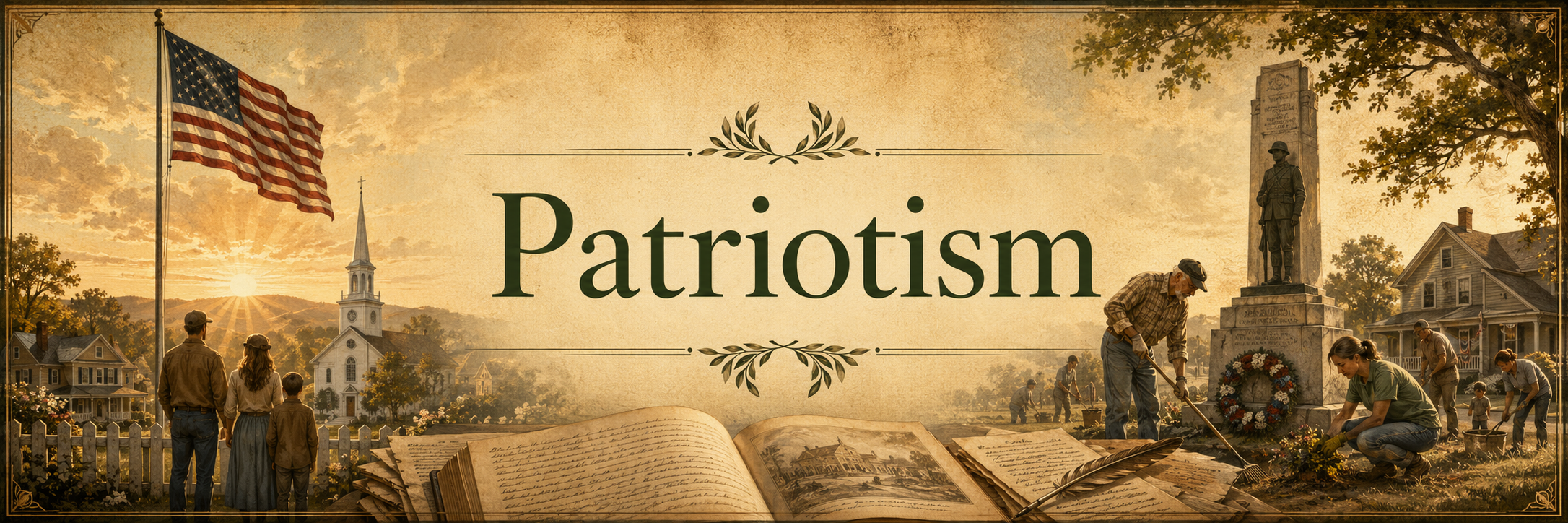
Patriotism at Our Soapbox
At Our Soapbox, patriotism is more than displaying the flag, singing the national anthem, or supporting a political party. It is expressed through truthfulness, responsibility, service, gratitude, and concern for our fellow Americans.
Guided by faith, we seek to strengthen our families, serve our communities, learn from our nation’s history, and contribute responsibly to the United States. We will not always agree, but we can listen respectfully, verify our claims, correct our mistakes, and remember that disagreement does not make us enemies.
Patriotism is not merely something we declare. It is something we practice.
What Patriotism Means at Our Soapbox
At Our Soapbox, patriotism means loving our country enough to serve it faithfully, study its history honestly, defend its founding principles, and work peacefully to correct its shortcomings.
Patriotism does not require us to agree with every government decision, political leader, or public policy. Responsible criticism can be an expression of love for our country when it is grounded in truth, offered respectfully, and directed toward constructive improvement.
We believe patriotism includes both gratitude and responsibility. We can appreciate the freedoms, opportunities, sacrifices, and achievements that have shaped the United States while also acknowledging the times when our nation has failed to live up to its principles. Honest history does not weaken patriotism. It helps us learn, grow, and become better stewards of the country entrusted to us.
No political party owns patriotism. Americans may hold different beliefs and reach different conclusions while still loving their country. Our responsibility is to examine ideas carefully, treat one another with dignity, and seek solutions that protect liberty, uphold justice, strengthen families and communities, and serve the common good.
Patriotism is more than a political identity. It is a commitment to responsible citizenship, truthful conversation, lifelong learning, and meaningful service.
God, Family, Community, and Country
Our understanding of service begins with God.
Our highest allegiance is not to a political party, public official, or nation. It is to God, whose truth should guide our character, decisions, relationships, and responsibilities. Our love of country must never become a substitute for faith or an excuse for dishonesty, injustice, hostility, or disregard for others.
Service to God should be reflected in how we care for our families. Families help pass faith, history, values, knowledge, and responsibility from one generation to the next. Serving our families includes keeping our commitments, caring for those who depend upon us, listening to one another, preserving family stories, and teaching younger generations how to participate responsibly in their communities.
Service also extends beyond our homes. Strong communities are built by people who are willing to help their neighbors, support those in need, preserve local history, care for shared resources, mentor others, participate in civic life, and offer their abilities where they can do genuine good.
Service to our country begins in these everyday responsibilities. It includes learning about our history and government, respecting constitutional and lawful processes, staying informed, participating peacefully, honoring those who serve, and treating fellow citizens with dignity—even when we disagree.
These commitments are connected, but they are not identical. God comes first. Guided by faith, we seek to strengthen our families, serve our communities, and contribute responsibly to the United States.
American Solutions Beyond Political Parties
The challenges facing our nation do not belong exclusively to Republicans, Democrats, or any other political group. They are American challenges, and addressing them requires us to look beyond party labels and carefully consider what will best serve our country and its people.
Political parties can help organize ideas, represent different priorities, and encourage citizens to participate. However, party loyalty should never replace independent judgment, personal conscience, or a commitment to truth. No party is correct about every issue, and no party is beyond honest examination.
At Our Soapbox, we believe ideas should be evaluated according to their merits—not simply according to who proposed them. A good idea does not become wrong because it came from another political party. Likewise, a harmful idea does not become right because it was promoted by the party we support.
Questions to Ask When Evaluating a Proposal
- What problem are we trying to solve?
- What reliable evidence helps us understand it?
- Is the proposal consistent with constitutional principles and the rule of law?
- Who may benefit, and who may carry the costs?
- What unintended consequences could result?
- Is the proposal fair, practical, and financially responsible?
- How will we know whether it succeeds?
- Can it be corrected if it does not work as intended?
An American solution will not always satisfy everyone or eliminate every disagreement. Some issues involve genuine differences in principles, priorities, and beliefs. Seeking common ground does not mean abandoning our convictions, and compromise is not always the proper answer.
It does mean applying the same standards to every party, listening to different perspectives, acknowledging legitimate concerns, and searching for the wisest course forward. We should be willing to support a sound proposal regardless of its political origin—and willing to question a poor proposal even when it comes from our preferred party.
We may not always reach the same conclusion, but we can begin with a shared commitment: to seek truth, protect liberty, uphold justice, respect human dignity, and strengthen the country we share.
America’s problems require more than Republican solutions or Democratic solutions. They require thoughtful, responsible American solutions.
Patriotism Through Learning and Service
Patriotism grows stronger when it is supported by knowledge, expressed through service, and practiced with humility.
Loving our country includes learning its history honestly. The story of the United States contains remarkable courage, sacrifice, innovation, and progress. It also includes conflict, injustice, failure, and lessons that should not be forgotten. Studying both the achievements and shortcomings of our nation helps us appreciate what has been accomplished while accepting our responsibility to improve what remains unfinished.
Responsible citizenship also requires lifelong learning. Public issues are often more complicated than political slogans or social-media posts suggest. Before forming conclusions or sharing information, we should seek reliable sources, examine original documents when possible, consider relevant historical context, and distinguish facts from opinions. We should also remain willing to correct ourselves when better evidence becomes available.
Learning, however, should lead to action.
Patriotism is practiced when we care for our neighbors, strengthen our families, preserve the stories of those who came before us, support veterans and public servants, participate in local affairs, and volunteer through trustworthy organizations. Service does not need to be public or dramatic to make a difference. A quiet act of kindness, a few hours spent helping a community organization, or time devoted to mentoring a younger person can strengthen the country from the ground up.
People can serve in different ways according to their abilities, resources, experience, and circumstances. Some may volunteer, mentor, teach, preserve history, attend public meetings, help a neighbor, or support a family in need. Others may contribute by listening, praying, researching an issue carefully, or helping someone distinguish reliable information from a misleading claim.
We should serve with humility, seeking to meet genuine needs rather than gain attention or recognition. We should listen to the people and communities we hope to help, respect their dignity, and work through responsible organizations when training, coordination, or safety measures are needed.
Patriotism is not measured only by what we say about America. It is also revealed by what we are willing to learn, preserve, improve, and contribute.
When we study honestly and serve faithfully, we help build stronger families, healthier communities, and a more responsible nation.
Respectful Discussion and Responsible Citizenship
A healthy nation depends upon citizens who can disagree without treating one another as enemies.
At Our Soapbox, respectful discussion does not mean avoiding difficult subjects, weakening our convictions, or pretending that every position is equally supported by evidence. It means expressing our beliefs honestly while recognizing the dignity of those who reach different conclusions.
Responsible discussion begins with truth. We should verify information before sharing it, distinguish facts from opinions, and examine claims from every political perspective by the same standards. When we make a mistake, we should correct it openly. Admitting an error is not a sign of weakness; it demonstrates integrity and respect for others.
We should address ideas, policies, and conduct without attacking a person’s character or worth. Disagreement does not prove that someone hates America, lacks faith, or intends harm. Before assigning motives, we should listen carefully, ask sincere questions, and make an honest effort to understand the other person’s position.
Responsible citizenship also requires action. Citizens should learn how their government works, remain informed through credible sources, participate in elections and public meetings, communicate respectfully with elected officials, and contribute peacefully to their communities. Criticism of government can be patriotic when it is truthful, lawful, and intended to encourage accountability or constructive change.
Our Discussion Principles
- Discuss the issue rather than attacking the person.
- Support factual claims with credible evidence.
- Clearly identify opinions and personal experiences.
- Describe opposing viewpoints fairly.
- Ask questions in good faith.
- Protect private and sensitive information.
- Reject threats, harassment, and dehumanizing language.
- Admit uncertainty when the facts are incomplete.
- Correct inaccurate information.
- Seek understanding even when agreement is not possible.
Every voice matters, but that does not mean every claim is automatically accurate. Our responsibility is to create a place where people can speak, listen, learn, and respectfully challenge ideas while remaining committed to truth.
We will not always agree—and we should not expect to. However, we can choose to disagree with integrity, listen with humility, and remember that our shared citizenship is greater than our political divisions.
Explore Our Monthly Patriotism Articles
The Patriotism page establishes the principles that guide Our Soapbox, but the conversation will continue through our monthly articles.
These articles will explore American history, responsible citizenship, faith and public life, community service, national observances, and the challenges facing our country. Some articles will celebrate important achievements and acts of courage. Others will examine difficult moments, competing viewpoints, or lessons we should not forget.
Future Topics May Include
- Faith and civic responsibility
- The meaning of American citizenship
- Understanding the Constitution and our system of government
- Military, veteran, and community-service stories
- American history and national observances
- The responsibilities that accompany our freedoms
- Evaluating public proposals beyond political-party labels
- Respectful disagreement in a divided culture
- Recognizing misinformation and verifying political claims
- Learning how local government works
- Preserving family stories of military and public service
- Practical ways to strengthen our communities
Our purpose will not be to tell readers what a political party wants them to believe. We will study each subject carefully, consult credible sources, distinguish fact from opinion, and acknowledge uncertainty or disagreement when it exists.
We will also welcome thoughtful participation. Readers may bring different experiences, beliefs, and political perspectives to the conversation. We ask only that everyone engage honestly, support factual claims with reliable evidence, and treat others with dignity.
Each article will offer an opportunity to learn, reflect, discuss, and act. Together, we can better understand our country, preserve the stories that shaped it, and consider how each of us can contribute to its future.
We invite you to return each month as we explore what it means to practice patriotism through faith, truth, learning, responsibility, and service.
Put Patriotism into Action
Patriotism becomes meaningful when our beliefs lead to responsible action.
Each person’s contribution will look different. Our age, health, abilities, experience, resources, and responsibilities may affect how we participate, but everyone can find a way to strengthen a family, help a neighbor, serve a community, or contribute to our country.
Consider Taking One Patriotic Action This Month
- Pray for our country, its people, and its leaders.
- Help a family member, neighbor, veteran, or person in need.
- Learn how one part of your local government works.
- Attend a town council, school board, or other public meeting.
- Volunteer through a trustworthy community organization.
- Preserve a family story of military, civic, religious, or community service.
- Study an important event in American history from credible sources.
- Examine one political belief using information from outside your usual sources.
- Correct an inaccurate claim you previously shared.
- Listen respectfully to someone whose political views differ from your own.
- Thank someone who serves your community.
- Help a younger person understand the responsibilities of citizenship.
Patriotic service does not need to be large, public, or dramatic. Quiet acts of honesty, kindness, responsibility, learning, and service help strengthen America from the ground up.
Will this strengthen my family, serve my community, promote truth, or help me become a more responsible citizen?
This month, I will put patriotism into action by ____________________.
Our country is strengthened when ordinary people faithfully accept responsibility for the places and people entrusted to their care.
Join the Our Soapbox Community
At Our Soapbox, our highest allegiance is to God. Guided by faith, we seek to strengthen our families, serve our communities, and contribute responsibly to the United States.
We believe our shared citizenship is greater than our political divisions. We can hold strong convictions while listening respectfully, examining evidence honestly, correcting our mistakes, and treating one another with dignity.
This page is only the beginning of the conversation.
We invite you to join the Our Soapbox email list and return for our monthly Patriotism articles. Together, we will explore American history, faith and civic responsibility, public service, constitutional principles, respectful disagreement, and practical ways to strengthen our communities.
Every voice matters, and every citizen has something to contribute. Bring your experiences, questions, knowledge, and convictions—but also bring a willingness to listen, learn, and serve.
Choose one practical way to serve God, strengthen your family, help your community, or contribute responsibly to our country this month. Then join us as we seek thoughtful American solutions grounded in faith, truth, responsibility, and service.
Patriotism is more than something we declare. It is something we practice—together.
 Our Soapbox, LLC